 Dr. Manuel Langer
Research stay
Valparaíso (Chile), 11/2015 - 01/20216
About me
Introduction | My academic career | Skills | Resume | Stays abroad | Certificates
Introduction
Ever since I was a child, I was fascinated by nature and the wonders of the world surrounding me. What excited me most was the vastness of space, our solar system, the stars and the whole universe. My curiosity was driving me to become a permanent resident of the local observatory and buying me a telescope from my first money I collected at the age of 14. But besides my fascination for astronomy, I was magically attracted by maps. Be it historical maps or the automobile club's road map of Europe. Placing me in front of an atlas would always be a save opportunity for my parents to collect some free time for themselves having me hypnotized for hours.
I just realized retrospectively, that my interests at the age of thirteen, would define the driving forces in school time, university studies, and following scientific topics throughout my life. To break it down to the smallest denominator: It was all about MAPS & PHYSICS.
My academic career
When I first encountered a special microscopy technique during my Lab Practical Training during my physics studies, it really puzzled me. This technique is called Kerr-Microscopy. I completely fell in love with this technique, since it allows for actually visualizing the microscopic directions of the magnetization within tiny structures. It simply fascinated me, that such a relatively simple technique like light microscopy combined with the magical property called 'light polarization' provides full access to the most relevant nanomagnetic properties and allows to map beautiful images of the micromagnetic orientation variations.
It works the following way: The local magnetic orientation is a vectoral property carried by the free electrons and its property 'the electron spin'. As electrons can be manipulated through electro-magnetic fields, the interaction with an incident light particle (photon) triggers an electron oscillation in the same way or orientation, as the polarization of the light. With a local magnetic field present through the local governing spin orientation inside the material, the polarization of light passing through the material is continuously rotated. This rotation of the lights polarization axis is in-turn proportional to the strength of the local magnetic field and can be measured with relatively simply means.
Skills
-
Programming
- Enthusiastic about programming since school
- Expert knowledge in array calculus and image analysis
- Matlab:
- Python:
- Flutter:
- .NET:
-
Administration
- Development of a company network
- Data management in Linux
-
Office Palette
-
Confident handling of all Office products
(Word, Excel, PowerPoint, Access, OneNote, etc.)
-
Confident handling of all Office products
- Radiation physics:
- Nanotechnology:
- Optics / Microscopy:
- Spintronics:
- Instrumentation:
- Vacuum technology:
- Radiation protection:
- IT skills:
- English:
-
Microsoft Excel Kurs
Hörmann Lernwelten 11/2024 -
Cyber Security Kurs
SoSafe 10/2024 -
Grundzüge Strl-Schutz Recht
Dr. C. Raetzke, INFORUM 11/2023 -
Matlab E-Learning
www.matlab-tutorials.de
Resume
VACUTEC GmbH
Physicist for Detector Development06/2024 - 06/2025
- Radiation protection officer (SSB)
- Research and development of radiation detectors
- Product manager for Geiger-Müller counting tubes and ionisation chambers for medical applications
- Apprenticeship at the Berufsakademie Riesa
VKTA
Strahlenschutz, Analytik & Entsorgung e.V.
Inspector in Radiation Protection06/2023 - 02/2024
- Supervision of radiation protection in buildings and facilities at the Rossendorf research site
- Participation in research projects and international studies on nuclear safety
- Release and disposal of substances from radiation protection areas
- Apprenticeship at the Berufsakademie Riesa
DEEPXSCAN GmbH
Product Manager for CT Devices10/2021 - 05/2023
- Development of X-ray CT devices for use in the fields of materials research, defect analysis and battery research
- Calculation of beam paths and photon efficiencies of X-ray optics
- Responsible for the realisation of the first customer order
- Coordination of publicly funded projects with partners from industry and research
PSI
Paul Scherrer Institute
Postdoc at the Swiss Light Source10/2017 - 09/2021
- Postdoctoral fellowship for the development and construction of a novel X-ray microscope based on the concept of ptychography
- Organisation and implementation of measuring times at the synchrotron
- Research on magnetic nanoparticles and nanostructures
- Development of novel optics and improved detectors with expert groups at PSI
- Supervision of Master's students
HZDR
Helmoltz-Zentrum Dresden-Rossendorf e.V.
Postdoc - Magnonics & Spintronics06/2017 - 07/2017
- Publication of own research results in scientific journals
- Realisation of measuring times at the synchrotron
09/2012 - 05/2017
- Topic: 'Spin waves - The transition from extended thin films to full magnonic crystals' (magna cum laude)
- Acquisition of diverse measurement methods for the characterisation of magneto-dynamic processes
- Close collaboration with theorists (USM Valparíso, Chile) resulting in four joint publications
- Involvement in the 'Kerr microscopy' experiment set-up in the HZDR school laboratory
TU Dresden
Technische Universität
Physics Studies10/2004 - 03/2012
-
Diploma thesis at the HZDR, Magnetism Group
Title: "Synthetic antiferromagnets: Production and characterisation of magnetic metamaterials"
(degree: 1.3) - Diploma degree: 1.6
Stays Abroad
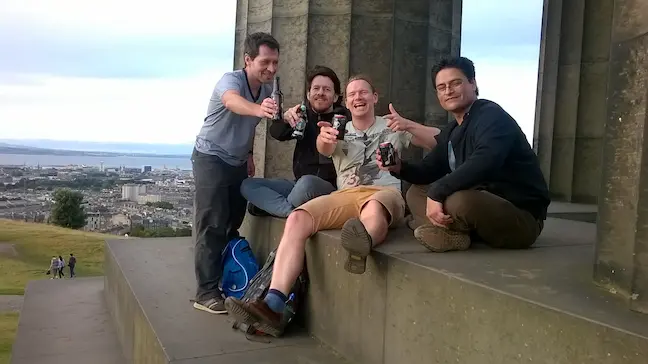
Work and Travel
South Africa, 04/2012 - 09/2012
South Africa, 04/2012 - 09/2012
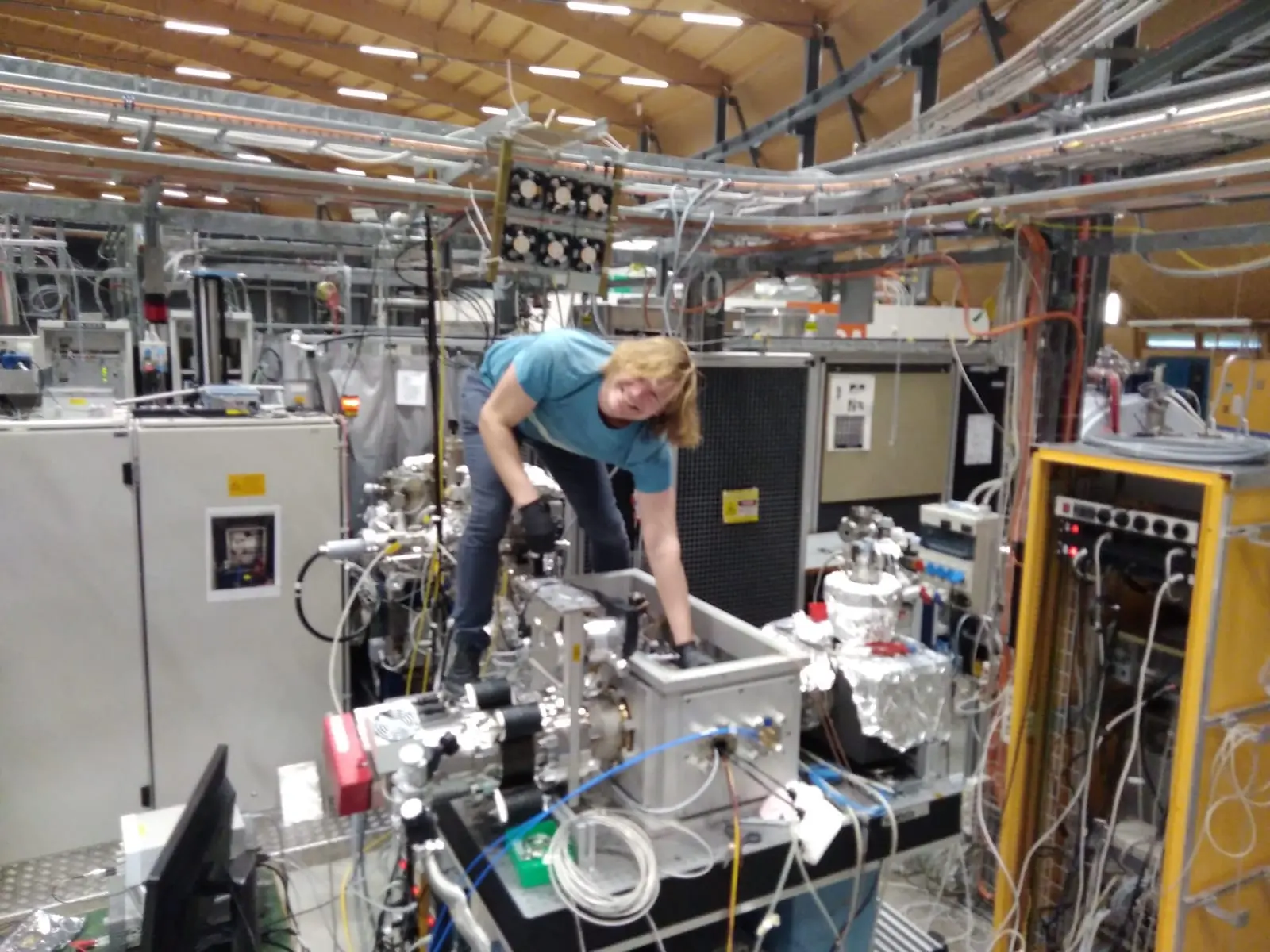
Work and Travel
Australia & NZ, 08/2008 - 03/2009
Australia & NZ, 08/2008 - 03/2009
Certificates
Fachkunde Röntgen
R1.1, R5.1
Fachkunde Strahler
S2.3, S5
Wirtschaftsethik
Dr. H. Schift
Wissenschaftskommunikation
Dr. S. Shephard
Karriereplanung
Dr. M. Clausen