 Dr. Manuel Langer
Publications
Diploma Thesis | PhD Thesis | Other Thesis
Diploma Thesis
This work as well as the subsequent paper attempted to address a problem related to micromagnetic data storage, as used in hard drive disks, where bits and bytes are stored based on the local direction of the magnetic orientation. This technique has reached its limit in terms of futher reducing the size of magnetic bits, primarily due to each bit generating its own magnetic field (called stray field). These fields can manipulate the orientation of neighboring bits by themselves and, thus, „erase" their data.
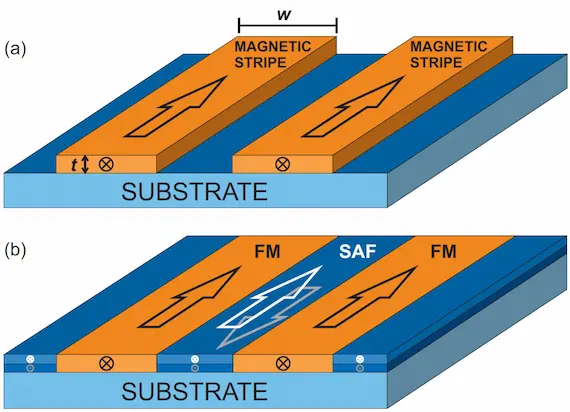
The goal in my work was to investigate magnetic double-layers, referred to as „synthetic antiferromagnets" which constist of two magnetic films with opposing magnetic orientations so that the effective stray field cancels out. By means of ion-irradiation, I locally mixed the two magnetic layers, resulting in this region becoming unidirectionally oriented magnetic elements or bits embedded in this „synthetic antiferromegnatic" environment (see Fig. 2).
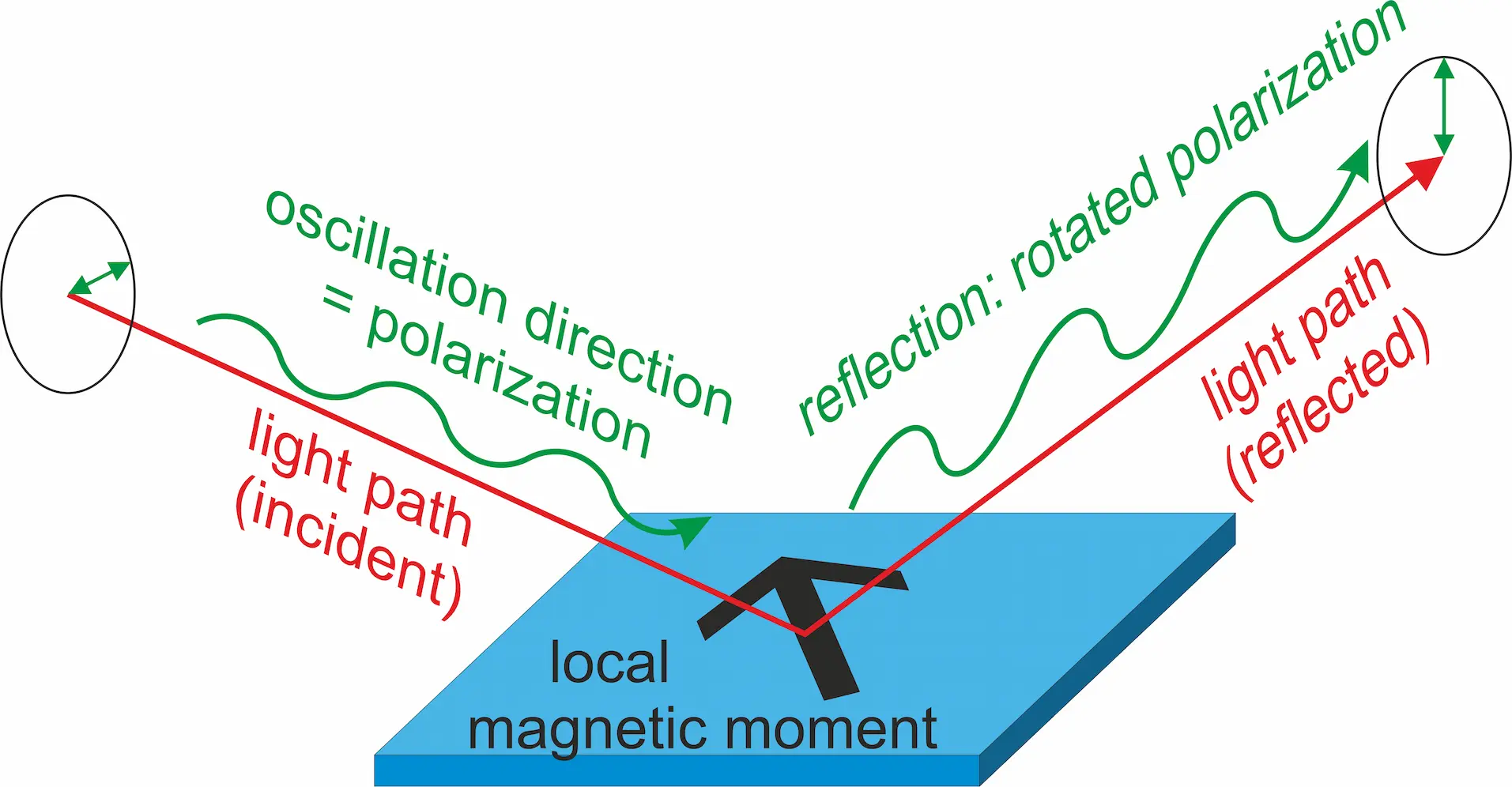
With the help of Kerr-micorscopy (see Fig. 1), I was able to demonstrate the feasability of this approach and show the improved switching behavior of embedded micromagnets compared to conventional magnetic bits.
PhD Thesis
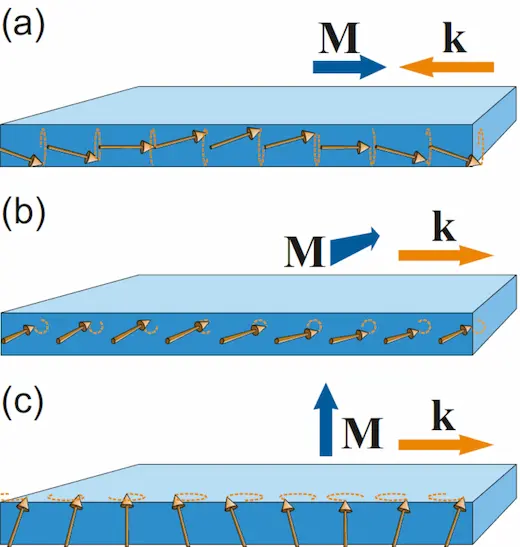
While the focus of my diploma work was mainly on the static, non-time-dependent behavior of micrometer-sized magnetic elements, I started to become more concerned with the time-dependent behavior of magnetic materials in my PhD Thesis. Most important aspect of my work became a collective phenomenon called „spin waves" aka. „magnons" (see Fig. 3). If you have an idea of what sound or a sound wave is, you can easily understand the concept of a „spin wave". Everyone who has once knocked on a metal tube, like the copper pipes used for the room heating, knows that this generates a sound wave travelling along the metal tube, allowing a person in the neighboring room to hear this wave as a sound coming from the heating pipe in his room.
What physically happens in the case of a sound wave is that by the knocking the atoms are pushed out of their previously fixed positions within the regular atomic lattice of the metal. Similar to a swing, they in-turn oscillate around their previous lattice position. The sound wave which we can hear is the spreading of this oscillatory atmic motion through the metal tube.
Similar phenomena occour with the magnetic orientation in metallic materials. If the magnetic orientation is „excited" or quickly reoriented in one location, it causes neighboring magnetic orientations to wiggle in response. This wiggling is transmitted to their neighbors and so on, resulting in a wave of magnetic reorientiation travelling along the material (illustrated in Fig. 3). Essential this is, what defines a spin wave.
At the beginning of my thesis it was only known, that by nano-patterning of materials, the properties of these spin waves can be manipulted. To understand this, imagine the metallic material as a lake. Waves on the surface of a lake can have any arbitrary periodicity, whether very small or broad, anything is possible. This, however, changes if there are periodic structures in this lake. Imagine trees planted periodically within this lake. The trees hinder larger waves from travelling through the lake and only allow tha travelling of waves to exist with a smaller wavelengths than the distance from one tree to another.
The point of this example is to provide a simple picture to understand that periodical structures lead to a filter-like behavior. And the same is true for spin-wave in patterned magnetic layers.
The main question I wanted to answer in my doctoral work was: What happens if you introduce very tiny periodic surface modulations on a thin magnetic film? How does this affect the behavior of spin waves? Or in our lake analogy: How will the waves behave if, instead of trees, there were swimming rings placed periodically on the surface of the water? Will the waves again show a fully continuous behavior, like in a normal lake? Or will they prefere certain wavelengths, as described for the lake with periodic trees inside?
The short answer is: „kind of both!". Interestingly, when I investigasted spin-waves in surface- modulated magnetic materials, I learned that the properties of the spin wave behavior were very similar to the unperturbed film (or continuous lake). But once spin waves were generated with a wavelength matching the imprinted periodicity of the surface modulation, interesting things started to happen: Clearly, there were two kinds of spin wave phenomena present: The original uniform spin wave, which was present in the magnetic film without modulation as well as a second standing spin- wave of precisely the same wavelenth as the modulation periodicity.
As the size of the modulation increased, the amplitude of the standing spin wave became larger compared to the uniform wave.
With this interesting observation,our first idea was to publish a paper on the use of surface- modulated magnetic films to precisely determine an important magnetic property: The exchange constant. It may not sound to fancy, but it was actually a neat solution to a real practical problem. For determining the exchange constant you need to create a spin wave. The spin wave geometry actually doesn‘t matter. But up until then, the exchange constant was always determined by measuring standing waves between the top and the bottom of a magnetic layer.
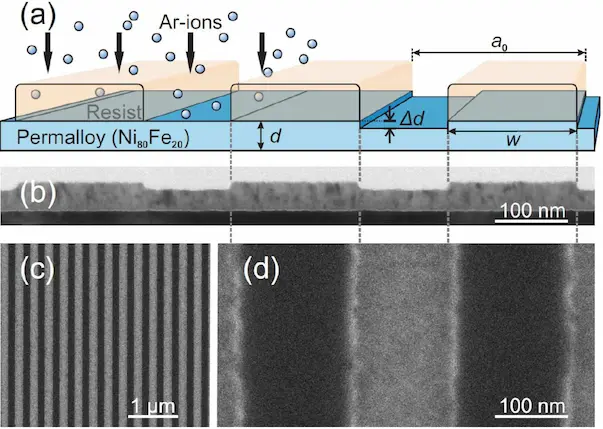
The analysis of these measurements were always unprecise due to several reasons, one being that the exact periodicity of the standing spin wave couldn‘t be fully controlled. By long-range lateral patterning of a magnetic thin film, this problem was solved in our appraoch: The Introduction of tiny periodic modulations on top of a fim and subsequently measuring lateral spin waves instead of vertical spin waves clearly improved the precision of the determined exchance constant. Fig. 4 shows the fabrication and the 3D structure of these surface-modulated magnetic films.
Other Thesis
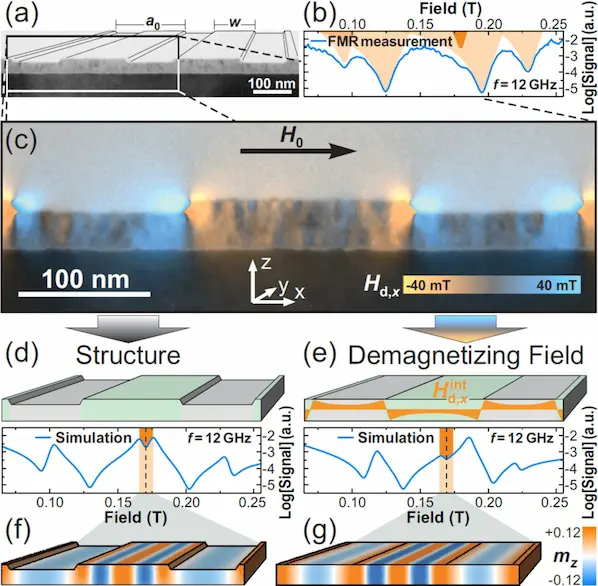
After this rather practical paper, my colleague Falk and I wanted to gain a deeper understanding of the physical origin of the existence and the size of standing spin waves in surface-modulated films. Falk was an expert in a microscopy technique called „transmission electron microscopy (TEM)". This technique has a very high sub-nanometer resolution, and with it, we were able to map the magnetic fields inside of these surface-modulated films. We extracted this very tiny field and demonstrated through simulation, that placeing only this periodic field in a magnetic film would always generate the same kind of standing spin waves as I measured before. Hence, the paper proved, that the physical origin of the standing spin waves were not pinning sites or local magnetic reorientations. The origin was the very tiny magnetic field variation caused by the edges at the film surface (see Fig 5).
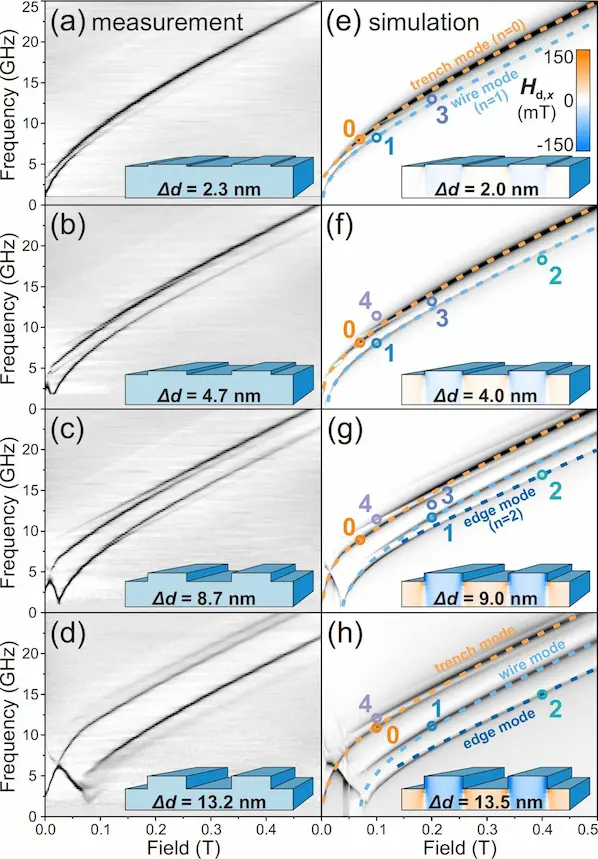
After this thourough examination of surface-modulated film, I spent my final 2 years of my PhD work on the investigation of „larger" modulations. Or more vividly: I was step-by-step intoducing trenches into a magnetic film until it was cut into a periodic arrangement of stripes. The latter structure is also known as „full magnonic crystal". With „magnonic" meaning „filter for spin waves" and „crystal" meaning „ periodic lattice structure". In the step-wise process of deepening the trenches between each stripe, we measured the Energy vs. Field dependence of the spin waves and compared this to simulations (see Fig. 6). In that way we were able to understand the evolution of a whole zoo of standing spin-wave modes within these structures and were able to formulate transition rules about how these spin waves evolve to loclized standing spin waves living in defined regions inside the structure. When I published my paper on the evolution of spin wave modes from a thin film to a full magnic crystal, the paper received the distinction „editors recommendation" to the reader.
The promising results I obtained during my thesis gave me quite some ideas about what I might do in my next position as a postdoc researcher in another institute. One idea woud influenced my future career significantly was to channelize spin waves in optimized suface-modulated structures.
The microscopic measurement technique which allowed me to measure such fascinating spin-wave propagation images is called Scanning Transmission X-ray Microscopy (STXM). After my PhD I decided to do exactly this and I left to switzerland to bulid „my own" X-ray microscope for nanoscale magnetic materials.